With the recent wigwam harvest comes a whole new issue: how to efficiently screen the volume of castings collected. My original method of an oversized colander into a tall bucket worked for one or two shoebox-sized Rubbermaid containers, but not so great for the giant heaps the wigwam produced.
Today I loaded the castings and shook and shimmied and scooped around then dumped the scrappy stuff- again and again and again and again- only to find I had done about a fifth to a quarter of the pile. I was starting to get blisters from screening!
Certainly there is a better way- HELP!
Keep in mind I currently operate out of my basement, so the new method has to be not only efficient but somewhat CLEAN. I can't have castings flying all over and about, so I have to find a way or system that can do more volume with minimal mess and space.
Please leave any suggestions or creative ideas for a clean, space saving method of screening by leaving a comment below. All ideas welcome!
December 31, 2008
December 26, 2008
Patience is a Virtue
I am still waiting patiently for the worm castings/vermicompost to dry that I recently harvested...zzzzzzzzzzz...I've read two different points on this matter:
1. The vermicompost shouldn't be allowed to dry out all the way because retaining a little of the moisture keeps the beneficial bacteria active in it
2. It doesn't matter if the vermicompost dries out because the beneficial bacteria is reactivated once it gets wet.
Both places I read these things seemed to be reputable sources. If anyone has any insight or a good answer to that, please let me know!
In the meantime I had a great Christmas Eve & Christmas Day- which resulted in a whole bunch of worm bowls ready for feeding. I plan to do some screening either Sunday, Monday, or Tuesday, depending on how my gift returning schedule pans out.
Tomorrow, it is time for twisting and bending adventures at an afternoon AcroYoga workshop. I have to keep in shape for all this harvesting!
December 16, 2008
The Moment We've All Been Waiting For.....
FINALLY it's the day I give the wigwam its first crank!
Before I get to the good stuff, you need some background and lead up info. First, the pic of the multitude of escapees I talked about in my last post: EEWWW! See what I mean? Soooo gross, even for a worm lover!!!
Next up is a before pic of the area where the long-awaited organic fertilizer would soon be falling. After all this time, I finally got to open the trap door!
The stuff already there must have fizzled down:

Newsflash: cranking the wigwam is a lot of work!
The crank moves real easy, that's not the issue.
It's just that only a little falls at a time so I was cranking like a maniac for five straight minutes. In the end, I had a humongous pile of scrumptious vermicomposty worm castings: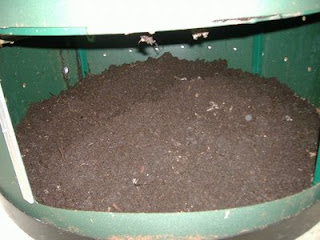
I put the castings in a large plastic bin so they could dry out before being screened (notice all the worm related equipment! I never thought I'd have a whole little workshop for worm poo!):
The level inside (where the worms are) fell about five to six inches with that cranking, and I didn't have enough room in the plastic container pictured above for all that dropped, happy day!
Of course, you all know about my penchant for saving small lives and even potential lives. I couldn't leave this post about the first crank without showing the valiant effort to save the extreme bottom dwellers of the wigwam:
I rescued about 10-15 worms out of the castings I cranked out. ANOTHER MYTH DEBUNKED- all the worms don't live in the top few inches where the food is. Some live in the very bottom layers and have to be forcefully relocated!
This made me wonder: what if I could tag the worms that I found so the next time I cranked I could see if the same ones were at the bottom again? This would also be helpful in the case of the escapees- I could tell if recent escapees were repeat offenders. Hmmm.....
ANYWAY, stay tuned for information on drying, screening, and packaging. Lilliworm rolls on!
Before I get to the good stuff, you need some background and lead up info. First, the pic of the multitude of escapees I talked about in my last post:
 EEWWW! See what I mean? Soooo gross, even for a worm lover!!!
Next up is a before pic of the area where the long-awaited organic fertilizer would soon be falling. After all this time, I finally got to open the trap door!
The stuff already there must have fizzled down:

Newsflash: cranking the wigwam is a lot of work!
The crank moves real easy, that's not the issue.
It's just that only a little falls at a time so I was cranking like a maniac for five straight minutes. In the end, I had a humongous pile of scrumptious vermicomposty worm castings:

I put the castings in a large plastic bin so they could dry out before being screened (notice all the worm related equipment! I never thought I'd have a whole little workshop for worm poo!):

The level inside (where the worms are) fell about five to six inches with that cranking, and I didn't have enough room in the plastic container pictured above for all that dropped, happy day!
Of course, you all know about my penchant for saving small lives and even potential lives. I couldn't leave this post about the first crank without showing the valiant effort to save the extreme bottom dwellers of the wigwam:

I rescued about 10-15 worms out of the castings I cranked out. ANOTHER MYTH DEBUNKED- all the worms don't live in the top few inches where the food is. Some live in the very bottom layers and have to be forcefully relocated!
This made me wonder: what if I could tag the worms that I found so the next time I cranked I could see if the same ones were at the bottom again? This would also be helpful in the case of the escapees- I could tell if recent escapees were repeat offenders. Hmmm.....
ANYWAY, stay tuned for information on drying, screening, and packaging. Lilliworm rolls on!
December 13, 2008
The Uncalm Before The Turn
Just a quick note before the first turn--- the word must be out in the wigwam that big things are about to happen. I have more escapees than ever!
Perhaps you may remember from an earlier post that some wanderers have seen fit to explore beyond the normal boundaries of their home and wedge themselves in between the outer wall and insulation piece.
My usual response is to yank the side back and quickly scoop the 10-20 defectors and return them to the middle of the bin.
Well, my past few look-sees have proven to be quite the rescue mission, as in HANDFULS of worms have begun to congregate in between.
I don't understand it: I haven't changed the conditions inside the bin, and the area they are congregated in has none of the benefits of being inside the bin- no food, no warmth, no moisture- yet the exodus continues.
Now maybe I am over-estimating how much of the herd is really migrating, because hopefully I have around 15-20 pounds of worms by now- so maybe a few handfuls is nothing.
But, I'm not gonna lie- the problem of rescuing handfuls of worms is more of a mental issue than an operational one. Handfuls of worms are kinda gross and when grabbed, extremely active- ew!
My hope is that the turn of the handle will lower the level and make the worms' supposed promised land between the walls a little more difficult to reach!
November 28, 2008
Pumpkin Shell Discovery
Despite my bragging about the worms loving pumpkins, it seems they only love the insides. Here's the small bucket of pumpkin shells I extracted from the bin today that were cleaned of their insides and starting to harden: But far more interesting (and photo worthy) were the pumpkin shells they hadn't quite finished just yet:
 When I lifted up some of the shells, the worms were congregated in the goo inside and kind of flopped out all together:
 This is almost too gross even for me!
ANYWAY, the final feeding before the first turn of the wigwam just took place. It was an extravagant post-Thanksgiving Day feast for the squirmers before a part of their world is cranked out and readjusted. This feeding brought everything up to within a few inches of the top of the bin.
Bin cranking countdown is T minus 7 days!
 But far more interesting (and photo worthy) were the pumpkin shells they hadn't quite finished just yet:
 When I lifted up some of the shells, the worms were congregated in the goo inside and kind of flopped out all together:
 This is almost too gross even for me!
ANYWAY, the final feeding before the first turn of the wigwam just took place. It was an extravagant post-Thanksgiving Day feast for the squirmers before a part of their world is cranked out and readjusted. This feeding brought everything up to within a few inches of the top of the bin.
Bin cranking countdown is T minus 7 days!
November 12, 2008
How Do The Pumpkins Grow?
FAST, that's how. In a matter of only a week and a half, all the pumpkin insides are eaten and pumpkin plants are sprouting! I mixed them back in real quick so the wormies could finish them off, too. As you can see from this pic, I am mere INCHES away from the top of wigwam FINALLY!
At this near momentous occasion, I would like to highlight some important things I've learned about worms in the past year or so that contradict what I had read to be true:
1. Worms don't eat their body weight, or even half their body weight, every day. Not even close.
2. Worms don't necessarily need their bedding to be sopping wet, or as some put it "able to squeeze a teaspoon of water out of handful of bedding". Baloney. They do just fine with it damp.
3. Worms will try to escape no matter how wonderful their environment. When I first got my worms, I used a lamp hooked to an outdoor Christmas light timer in my basement to keep them in. I was feeding them all sorts of wonderful scraps and some were still bent on creeping out- light/no light, delicious scraps/crappy scraps. It didn't matter. Just like people, some just need to get away! Whatever!
4. Worms don't go sterile if you touch them too much. Believe you me, I am always mixing them around, picking them up and examining them, plucking them off the top of the bin and tossing them back in, removing them briefly from the bin to take photos, and they seem to be multiplying just dandy. I estimate I now have about 15 pounds worth, although it is impossible to know exactly.
Those are the most significant that I can think of right now. If you need any worm myths proven or debunked, let me know!
 I mixed them back in real quick so the wormies could finish them off, too. As you can see from this pic, I am mere INCHES away from the top of wigwam FINALLY!
At this near momentous occasion, I would like to highlight some important things I've learned about worms in the past year or so that contradict what I had read to be true:
1. Worms don't eat their body weight, or even half their body weight, every day. Not even close.
2. Worms don't necessarily need their bedding to be sopping wet, or as some put it "able to squeeze a teaspoon of water out of handful of bedding". Baloney. They do just fine with it damp.
3. Worms will try to escape no matter how wonderful their environment. When I first got my worms, I used a lamp hooked to an outdoor Christmas light timer in my basement to keep them in. I was feeding them all sorts of wonderful scraps and some were still bent on creeping out- light/no light, delicious scraps/crappy scraps. It didn't matter. Just like people, some just need to get away! Whatever!
4. Worms don't go sterile if you touch them too much. Believe you me, I am always mixing them around, picking them up and examining them, plucking them off the top of the bin and tossing them back in, removing them briefly from the bin to take photos, and they seem to be multiplying just dandy. I estimate I now have about 15 pounds worth, although it is impossible to know exactly.
Those are the most significant that I can think of right now. If you need any worm myths proven or debunked, let me know!
November 3, 2008
Useful Jack-O-Lanterns
 These pumpkins were artfully carved for Halloween this year (mine has the tongue sticking out a la Gene Simmons style). Their artfully carved parts and gooey insides ended up in the latest worm bowl (along with some strawberry tops):
 Then, we roasted the pumpkin seeds with some EVOO and steak seasoning. Essentially we were able to make use of the whole pumpkin- very environmentally friendly.
I have no idea how long it takes pumpkin parts to rot, so before I go gangbusters and toss in entire pumpkins for the worms to devour, I am going to see how long it takes them to finish these small pumpkin parts.
Did you know that pumpkins were first carved back in the 1700's to welcome back dead relatives and scare off evil spirits? I learned all kinds of interesting stuff at the Pumpkin Patch.
If I find out pumpkins rot fast enough, I am going to cut the jack-o-lanterns into pieces and drop them in.
Hopefully, this Halloween symbol will symbolize the last feeding before the big crank of the Wigwam!!!
Subscribe to:
Posts (Atom)


 Posts


